
Uplift Appalachia: Equipping and Empowering the Church to Support Recovery (Podcast)
>> Listen on Spotify, Apple or Soundcloud
You’ve been released from jail, where you spendt some time for possession of narcotics. In jail, you got sober. And you were lucky: your jail had some programs that helped start you down a path of long-term mental and physical wellbeing. But you still have cravings. They gnaw at you as you return to the outside world.
You manage to find a job and a place to stay, and you’re starting to build a new life. But also, you don’t have a car—it was impounded when you were incarcerated, and you can’t yet afford to get a new one. And you have a court date in the next town over, and the bus only takes that route once a day. You’re going to have to make sure you can take off work, even if you can’t really afford to. And those cravings are still there, at the back of your mind.
This is the kind of dilemma that faces many people in Tennessee: staying in recovery while trying to rebuild a life, but resources are limited and local public transportation is not reliable or readily available. This has been identified in dozens of needs assessments across the state as a major barrier to recovery.
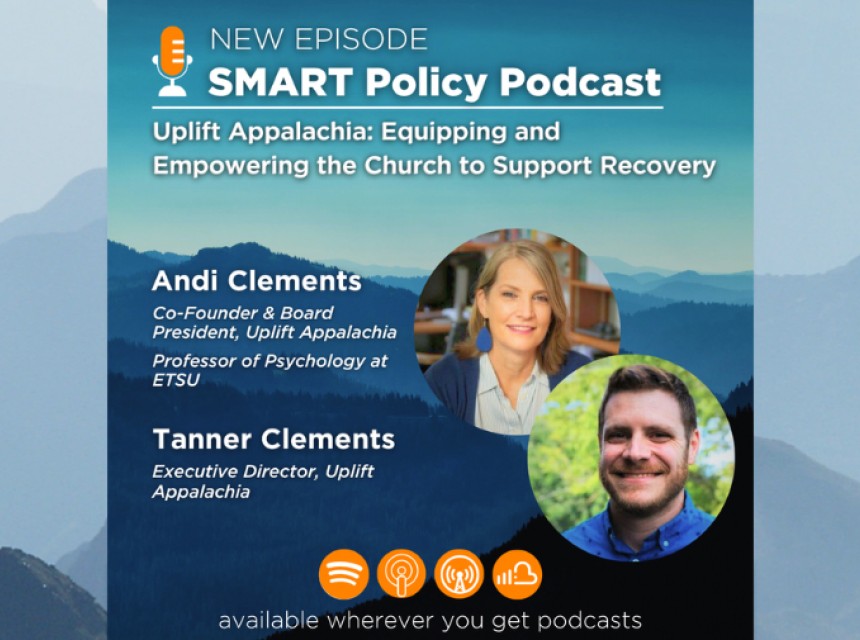
This is where many people believe that church can have a massive impact. Andi and Tanner Clements of Uplift Appalachia think so, too. For a few years now, their church and others they have mentored have provided transportation to courts, recovery meetings, job trainings and more, with the goal of helping people not only survive, but thrive.
Uplift Appalachia provides education, training, consulting and connection to churches and organizations, motivating and equipping them to love and serve those living with addictions, mental health and other life challenges on their journey to flourishing. They also have a three-year grant to cross-train faith, health and social service communities about addiction and trauma.
Learn more:
- Uplift Appalachia (including Intrinsically Motivated podcast)
Clements, A. D. (2023). The Trauma Informed Church: Walking with Others Toward Flourishing: 2nd Edition with Study Guide. Uplift. ISBN: 979-8-9870371-1-9. - Clements, A. D., Clements, T., & Hedrick, M. J. (2025). Interpersonal connection and medication for opioid use disorder (MOUD): Does the endogenous opioid system inform the etiology and treatment of addiction? Available at SSRN: https://ssrn.com/abstract=5363291 or http://dx.doi.org/10.2139/ssrn.5363291
- Clements, A. D., Cyphers, N. A., Whittaker, D. L., Hamilton, B., & McCarty, B. (2021). Using trauma informed principles in health communication: Improving faith/science/clinical collaboration to address addiction. Frontiers in Psychology: Health Psychology, 12, Article 781484 https://doi.org/10.3389/fpsyg.2021.781484
- Clements, A. D., Cyphers, N. A., Whittaker, D. L., & McCarty, B. (2021). Initial validation and findings from the willing/ready subscale of the Church Addiction Response Scale (CARS). Frontiers in Psychology: Health Psychology, 12, Article 733913. https://doi.org/10.3389/fpsyg.2021.733913
Original music by Blind House. Hosted and produced with additional scoring by Jeremy Kourvelas.