
What the Brain Disease Model of Addiction Gets Right—and What It Misses (Podcast)
Something really has changed over the past 20 years, especially in the last ten. Our culture has increasingly come to accept the idea that addiction is a chronic, treatable disease, not a moral failure.
Secretary RFK Jr. of the Dept. of Health and Human Services said this almost word-for-word just about a month ago when President Trump signed the Executive Order establishing the Great American Recovery Initiative, adding that for too long we have treated substance use disorder with “fragmentation, stigmatization and silence instead of science, compassion and coordination.”
In the field of science, both clinical and academic, this is often referred to as the “brain disease model of addiction,” based on the definition of a disease as a condition that changes the structure or function of at least part of an organ or system.
However, though this framework has done a lot to reduce stigma and increase the acceptance of evidence-based treatment, you don’t have to go looking very long before you see that our healthcare, housing and criminal justice systems are still stuck in the past. And on top of that, the recovery community itself remains split on what it even means to have the disease of addiction.
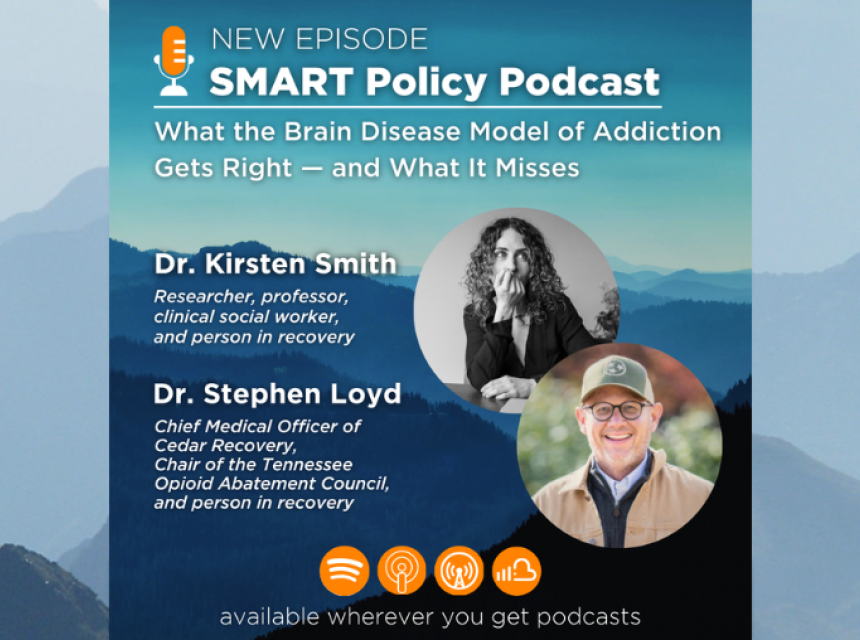
My guests this month are Dr. Kirsten Smith, a researcher and clinical social worker who found recovery and earned her doctorate after going to prison for robbing banks to pay for heroin, and Dr. Stephen Loyd, chief medical officer of Cedar Recovery and chair of the Tennessee Opioid Abatement Council, who is also in recovery from opioid and benzodiazepine use disorder.
Dr. Smith was recently featured in an article by the Guardian, wherein she offered some intriguing criticisms and limitations of the brain disease model. It caught our attention at the SMART Initiative, as well as that of Dr. Loyd. Fortunately, the two agreed to come onto our show for a deep dive, and, as you can see, this episode turned out to be longer than normal.
It also contains some concepts that some might find controversial. Additionally, though we frequently discuss drug use on this show, we get a bit up close and personal to the topics of cravings, recovery and more, so some listener discretion is advised. And as always, this episode is intended to be educational, showcases the personal opinions of the guests and does not reflect any opinion or belief of the University of Tennessee.
That being said, I found this conversation to be insightful and challenging, with compelling takeaways for everyone, no matter where they stand on the matter.
Learn more:
- Dr. Stephen Loyd
- Dr. Kirsten Smith
- Dr. Alan Leshner’s 1997 paper on the brain disease model of addiction
- “Behave” by Robert Sapolsky